

Last updated: 4 September 2026
A budget can become difficult to defend when the business has changed, but its assumptions have not. A department may continue receiving the same amount of funding as last year, even though its activities, priorities or expected contributions have changed.
For CFOs and finance teams, zero-based budgeting (ZBB) provides an alternative way to reassess spending and make more informed decisions aligned with the company’s strategy, operational activity, risk, and measurable financial outcomes.
Read more: The Complete Guide to Corporate Budgeting
What is Zero-based budgeting?
Zero-based budgeting is a budgeting method that allocates funding based on current activities and requirements rather than historical budget levels. Under ZBB, previous spending does not automatically receive approval in the next budget cycle; proposed expenditure is reviewed and justified before resources are allocated.
With zero-based budgeting:
- Projected expenses must be forecasted from the baseline of “zero” (thus the method’s name)
- Projected expenses should have no reference to, and causal relationship with, the actuals stated on the past financial records
- Every expense must be justified based on the level of its relevance and significance to the project and/or the business
These qualities make zero-based budgeting a rigorous and comprehensive approach to budgeting, which entails not only substantial and profit-driving benefits but also a few major drawbacks. Nevertheless, “zero-based” does not mean that every business activity literally starts with $0. It simply means historical expenditure is not treated as an automatic baseline.
For example, a finance department has a previous-year software budget of $500,000. Under incremental budgeting, a 5% increase would produce a $525,000 allocation. Under ZBB, the team would identify current requirements, for example, essential systems, regulatory reporting, analytics and discretionary tools, and justify the resources required for each. Management can then determine whether $525,000 is justified, whether spending should be reduced, or whether resources should be redirected.
The important difference is how the budget is justified, not simply whether the final number is higher or lower than last year.
What is the history of zero-based budgeting?
Zero-based budgeting is generally associated with Peter A. Pyhrr, who developed the approach at Texas Instruments and published the concept in the Public Administration Review in 1977. The original approach used “decision packages” to describe activities in terms of their purpose, resource requirements and expected benefits, allowing management to evaluate and rank competing requests.
The concept later gained attention in government budgeting and corporate finance as organisations sought more rigorous approaches to cost management and resource allocation. McKinsey notes that modern ZBB has evolved beyond rebuilding an entire budget from scratch, with contemporary approaches combining spending reviews, financial performance management and broader cost-management practices.
What are the differences between zero-based budgeting and incremental budgeting?
The 5 fundamental differences between zero-based and incremental budgeting approaches are as follows:
![[infographic] what are the differences between zero based budgeting and incremental budgeting](/_next/image/?url=https%3A%2F%2Fblog.trginternational.com%2Fhs-fs%2Fhubfs%2F%255Binfographic%255D%2520what%2520are%2520the%2520differences%2520between%2520zero%2520based%2520budgeting%2520and%2520incremental%2520budgeting.png%3Fwidth%3D797%26name%3D%255Binfographic%255D%2520what%2520are%2520the%2520differences%2520between%2520zero%2520based%2520budgeting%2520and%2520incremental%2520budgeting.png&w=2048&q=75)
Neither approach is universally superior. Incremental budgeting can be efficient when historical spending reliably predicts future requirements. ZBB is more useful when management needs to challenge established spending patterns or redirect resources towards new priorities.
Read more: Incremental vs. Zero-Based Budgeting: Which Approach is Right for You?
How does zero-based budgeting work?
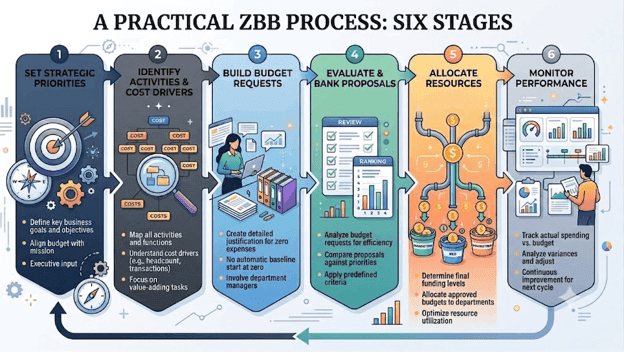
1. Set strategic priorities
Finance and business leaders first establish what the organisation needs to achieve. Priorities may include improving operating margin, entering a new market, increasing capacity, improving customer experience, reducing unnecessary costs, strengthening compliance or investing in digital transformation.
These priorities become criteria for evaluating budget requests.
2. Identify activities and cost drivers
Budget owners identify the activities requiring funding and the factors that drive their cost. Instead of asking only, “How much did we spend last year?”, the finance team asks: “What are we doing, what resources does it require, and what drives the cost?”
For a hotel, activities may include housekeeping, front-office operations, food and beverage, guest services, marketing and property maintenance. Cost drivers may include occupied rooms, employees, transactions, revenue or service volume.
3. Build budget requests
Each activity becomes a funding request. A strong request should explain:
- What activity is being funded?
- Why is it necessary?
- What resources are required?
- What outcome is expected?
- What happens if it is reduced or removed?
- Which strategic priority does it support?
The starting point is therefore the activity and its resource requirement—not “last year’s amount plus or minus 5%.”
4. Evaluate and rank proposals
Management evaluates competing requests against criteria such as strategic alignment, necessity, financial impact, customer impact, risk and alternative delivery options, then ranks proposals by importance and expected value. Resources are allocated after activities have been evaluated, rather than because they existed in the previous budget.
5. Allocate resources
Once proposals are ranked, management allocates resources within financial constraints. This does not necessarily mean reducing total spending.
For example, if a company identifies $200,000 of low-priority expenditure but has strategic initiatives requiring $150,000, ZBB can provide a basis for redirecting resources rather than treating cost reduction as the final objective.
6. Monitor performance
ZBB should continue after approval. Finance teams should compare budget, forecast and actual performance, investigate material variances and reassess assumptions when conditions change.
What are the pros and cons of the ZBB approach?
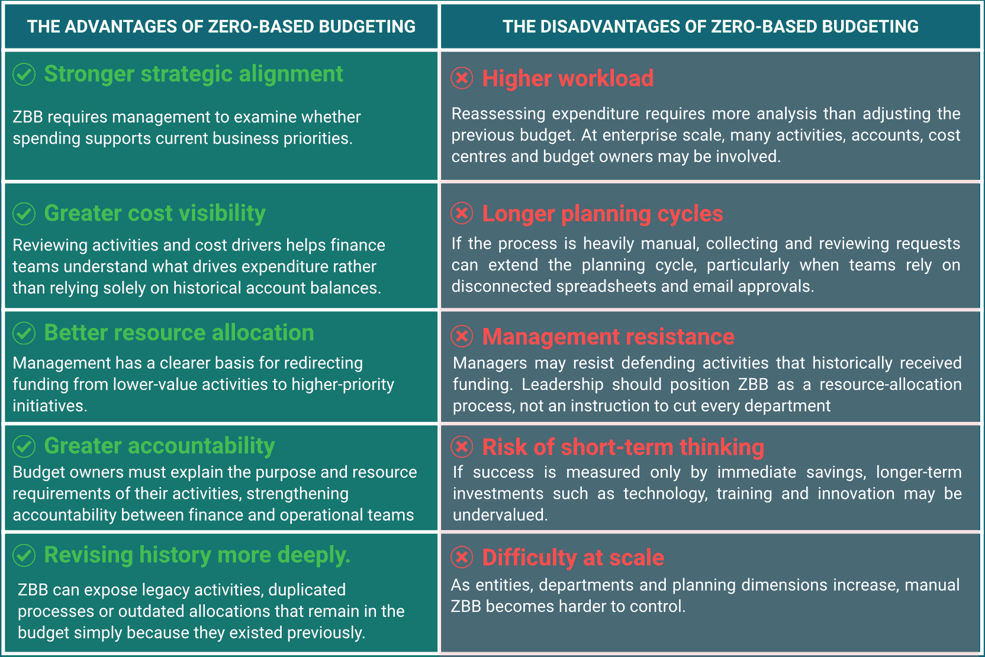
Zero-based budgeting enforces strict financial discipline by requiring every expense to be justified from scratch, driving cost efficiency and strategic alignment. However, this approach demands significant time, specialised training, and administrative resources that can disrupt daily operations.
When should a company use zero-based budgeting?
ZBB is most relevant when an organisation has a reason to challenge its existing cost structure. It is particularly suitable when:
- Strategic priorities have changed significantly.
- Costs have increased without a clear connection to performance.
- The organisation is restructuring or transforming.
- Management needs greater visibility into discretionary expenditure.
- Legacy activities have accumulated over multiple cycles.
- Resources need to move towards new growth opportunities.
- Finance and operational leaders need a stronger basis for challenging requests.
The practical question is: “Which parts of our cost structure require a fresh justification?”
Read more: Fixed Forecasting vs. Rolling Forecasting: Which One Is Right for You?
5 key tactics to effectively carry out a ZBB program
A common characteristic of businesses that have successfully implemented ZBB is that it takes more than the efforts of the finance function alone.
Read more: The Collaboration Gap in Hospitality: Why Revenue Managers and CFOs Rarely Budget From the Same Page
McKinsey has studied and put together 5 key aspects of a successful ZBB program:
Go big
In comparison with the traditional way of cutting costs, zero-based budgeting quantifies the cost drivers from the bottom up, without being influenced by multiple anchors – attributes like this year’s budget and previous years’ spending. As financial professionals can now access financial data, they can separate productive from unproductive spending.
With data and new technologies, information is constantly updated, allowing leaders to set new financial-productivity goals and reassess much more frequently. Backed up by insights and data on how much they should spend and what costs to cut, leaders are free to set new spending levels that can be much bolder than the traditional “cut x per cent” mandate.
Specifically, setting the goal for the fiscal year to move 20 per cent of advertising spend to digital channels can seem ambitious at the start of the year, yet by April, this goal can become too conservative if a new social media campaign suddenly explodes.
In contrast, if sales rate falls in line with TV spending levels, then the goal is now unachievable. Depending on the context, financial leaders can evaluate and reassess their decisions accordingly.
Read more: The Use of Spreadsheets and Modern Cloud Adoption in Businesses
Go deep
The governance structure that controls the entire program is one of the key factors contributing to the success of the new cost management strategy. In traditional practice, budgeting programs are founded on temporary teams, such as project-management offices, or are delegated to the heavily burdened finance function. Meanwhile, to run a successful ZBB program, it requires a new, stronger governance structure that becomes a permanent part of ongoing business.
First, an experienced leader – the ZBB director is crucial to guide everyone heading towards one mutual direction. Because the ZBB program’s role is to fuel the company’s strategic priorities, the leader must stress the program’s importance and steer through the challenges it brings.
Secondly, the leader needs a small team of Finance, IT, HR, and Finance professionals - also called the “centre of excellence” (COE) group, to help keep the tactical and the discipline of the entire ZBB program in place.
Finally, a sustainable, continuously improved ZBB program must involve the role of the cost-category owner (CCO), who monitors the related subcategories of expenses. This role is typically delegated to the highest-performing individuals in the organisation, those who are able to set the targets and guidelines, challenge their peers to reach the goals, roll out the best practices across the business, and drive steady improvement in spend efficiency.
Go long
If you want to establish a ZBB program that can last as the organisation develops, you need to build it into new performance-review practices.Since ZBB creates major changes to the organisation, it should be carried out carefully. The program must ensure that the incentives fully align with the organisation’s demands—which change over time as its experience with ZBB deepens.
Organisations can choose their own approaches and adjust performance metrics to confirm people’s responses. Either offering an individual bonus to those who overperformed the targets, or an organisation-wide bonus if the company surpassed the targets, would work, depending on your aspired outcomes.
Penalties for those who underperformed against their targets are also needed for the ZBB program to have full effect. Yet, over time, individual bonuses seem more effective and important for stimulating innovation and improvement.
Read more: Getting rid of Excel in financial planning and budgeting: modern trend for CFOs

Go wide
Re-investments are as important as the budget-cutting process. Progress in identifying, prioritising, and proving reinvestments can be seen as an opportunity to fuel growth, boost productivity, and ignite people’s enthusiasm to work toward mutual goals.
The employees’ proposals on reinvestment practices are also highly valued. ZBB leaders must clearly state that the transformation was not only about cutting costs, but also about freeing up funds to realign spending with strategy. The more transparent this process is, the better it reassures employees that the new approach is working and sustainable over time.
Go all in
Lastly, the final element that supports ZBB success is making the changes visible and tangible to everyone in the organisation. For example, launch a social media campaign to publicise the new approach, using tools like hashtags and viral-video contests. Internally, it is also important to provide support to the employees at every level – the ones who are making crucial decisions and making the ZBB work for the organisation.
Because the ZBB budget is transparent, ROI calculations are more robust, allowing decision-makers to be more confident signing off on investments with longer-term pay-outs. The adjustments that were made in the effects of the ZBB program, making it a long-term practice across the organisation, applying to every aspect of the business from monthly, yearly to become an annual routine of every individual in the company.
How can technology support zero-based budgeting?
The principles of ZBB do not require dedicated software. The practical challenge is managing the volume of data, submissions, approvals, scenarios and revisions involved in a complex planning cycle.
Enterprise performance management (EPM) software can support this process.
Centralised planning data
Finance teams need consistent financial and operational information when evaluating requests. TRG’s Infor EPM solution provides a centralised environment for planning, budgeting, forecasting, reporting, and performance management, including creating plan hierarchies, comparing plans with forecasts, and adjusting plans as conditions change.
Workflow and approvals
ZBB requires requests to move through review and approval stages. Infor EPM uses workflow tasks, financial planning steps, entities and budget versions to manage planning activities.
Scenario modelling
ZBB decisions involve trade-offs. Management may compare maintaining, reducing or eliminating an activity, or reallocating its resources. TRG’s Infor EPM solution supports what-if modelling and multiple financial scenarios, allowing finance teams to evaluate potential outcomes before making planning decisions.
Budget-to-forecast comparison
ZBB should not end when the annual budget is approved. Infor EPM supports comparing plans with forecasts and adjusting plans as circumstances change, helping finance teams connect budget, forecast and actual performance.
A practical ZBB example for a finance team
Consider a regional hospitality group reviewing a $1 million corporate marketing budget. Instead of applying an incremental increase, the team breaks the allocation into activities:

Finance and marketing leaders can rank each activity by strategic importance, expected value, operational necessity, and risk.
The final budget might still be $1 million, lower, or $1 million with resources redistributed. The outcome depends on justification and priorities, not a predetermined instruction to reduce spending.
Explore more: What Is Infor EPM? A Complete Guide to Financial Planning, Budgeting, and Forecasting
TRG’s recommendation: Making ZBB manageable at scale
The practical challenge with ZBB is managing the volume of decisions behind the methodology. The process can involve budget versions, decision packages, approval workflows, financial assumptions, operational drivers and scenario comparisons.
For ZBB, technology should not replace management judgment. Instead, implementing a solution like Infor EPM can make decisions more controlled and traceable through centralised planning information, structured submissions, decision packages, automated workflows, multiple budget versions, scenario analysis, and budget-to-forecast comparisons.
The objective is not simply a smaller budget. It is a clearer basis for deciding where resources should go and why.
Key takeaways
- Zero-based budgeting starts with current activities and requirements rather than automatically carrying forward historical spending.
- ZBB requires budget owners to justify expenditure based on necessity, strategic alignment, resources, and expected outcomes.
- Its advantages include stronger cost visibility, strategic alignment, accountability and resource allocation.
- Its challenges include additional time, management involvement and complexity.
- Technology can support ZBB through decision packages, workflow, scenario modelling and budget-to-forecast analysis.
- ZBB can be applied selectively rather than replacing every budgeting method.
Frequently Asked Questions
What is zero-based budgeting?
Zero-based budgeting (ZBB) requires planned expenditure to be justified by current activities, needs, and priorities rather than automatically carrying forward the previous budget.
How does zero-based budgeting work?
The process involves setting strategic priorities, identifying activities and cost drivers, preparing requests, evaluating proposals, allocating resources and monitoring performance.
What are the advantages of zero-based budgeting?
The main advantages are stronger strategic alignment, greater cost visibility, more rigorous expenditure review, increased accountability and the ability to redirect resources.
What are the disadvantages of zero-based budgeting?
ZBB requires more time, management involvement and analytical effort than incremental budgeting. It can also introduce complexity, training requirements and longer planning cycles.
When should a company use zero-based budgeting?
Companies should consider ZBB when they need to challenge established spending patterns, improve cost transparency, reassess activities or redirect resources because strategic priorities have changed.
Learn more about budgeting and financial planning
Read TRG’s Understanding the 5 Most Common Budgeting Approaches and Their Pros & Cons to compare ZBB with incremental, rolling, activity-based and performance-based budgeting.
For broader planning guidance, read TRG’s Enterprise Budgeting Guide.
Explore TRG’s Infor EPM solution to see how enterprise planning technology supports budgeting, forecasting, workflow, scenario modelling and performance management.